what is the name given to the path of the earth as seen from the sun?

The ecliptic is the airplane of Earth's orbit around the Sun.[1] [2] [a] From the perspective of an observer on Earth, the Sun's movement around the angelic sphere over the course of a yr traces out a path along the ecliptic against the background of stars.[iii] The ecliptic is an important reference plane and is the basis of the ecliptic coordinate organisation.
Sun's credible movement [edit]
The ecliptic is the credible path of the Sun throughout the course of a year.[4]
Considering Earth takes one year to orbit the Sunday, the credible position of the Sun takes 1 twelvemonth to make a complete circuit of the ecliptic. With slightly more than 365 days in one twelvemonth, the Sun moves a piddling less than one° eastward[5] every twenty-four hours. This small departure in the Sun's position against the stars causes any detail spot on World's surface to take hold of upwardly with (and stand straight north or s of) the Sun about four minutes later each twenty-four hour period than it would if Earth did not orbit; a day on Earth is therefore 24 hours long rather than the approximately 23-hour 56-infinitesimal sidereal 24-hour interval. Again, this is a simplification, based on a hypothetical World that orbits at uniform speed around the Sun. The actual speed with which Earth orbits the Sun varies slightly during the year, then the speed with which the Lord's day seems to move along the ecliptic also varies. For instance, the Sun is north of the celestial equator for about 185 days of each year, and due south of information technology for most 180 days.[half-dozen] The variation of orbital speed accounts for part of the equation of time.[vii]
Considering of the movement of Globe around the Earth–Moon heart of mass, the apparent path of the Sun wobbles slightly, with a catamenia of most one month. Because of further perturbations by the other planets of the Solar Arrangement, the Earth–Moon barycenter wobbles slightly around a hateful position in a complex way.
Human relationship to the celestial equator [edit]
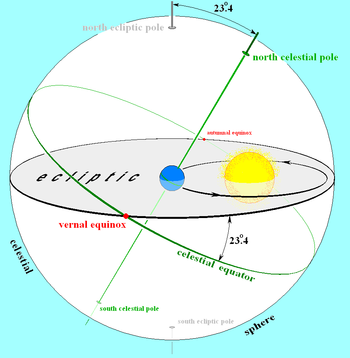
The airplane of Earth's orbit projected in all directions forms the reference plane known as the ecliptic. Hither, it is shown projected outward (grey) to the celestial sphere, forth with Earth'south equator and polar axis (green). The aeroplane of the ecliptic intersects the angelic sphere forth a great circle (black), the same circle on which the Dominicus seems to movement every bit Globe orbits it. The intersections of the ecliptic and the equator on the angelic sphere are the vernal and autumnal equinoxes (red), where the Sunday seems to cross the angelic equator.
Because Globe's rotational axis is non perpendicular to its orbital aeroplane, Earth's equatorial aeroplane is not coplanar with the ecliptic plane, only is inclined to it by an bending of nearly 23.4°, which is known as the obliquity of the ecliptic.[8] If the equator is projected outward to the angelic sphere, forming the angelic equator, it crosses the ecliptic at ii points known as the equinoxes. The Sun, in its apparent motion along the ecliptic, crosses the celestial equator at these points, one from s to n, the other from north to southward.[5] The crossing from south to northward is known as the vernal equinox, too known as the beginning indicate of Aries and the ascending node of the ecliptic on the angelic equator.[9] The crossing from north to south is the autumnal equinox or descending node.
The orientation of Earth's axis and equator are not fixed in infinite, merely rotate about the poles of the ecliptic with a period of nigh 26,000 years, a process known as lunisolar precession, as it is due mostly to the gravitational effect of the Moon and Dominicus on Earth's equatorial bulge. Likewise, the ecliptic itself is not stock-still. The gravitational perturbations of the other bodies of the Solar Arrangement cause a much smaller motion of the plane of Earth'south orbit, and hence of the ecliptic, known every bit planetary precession. The combined activity of these 2 motions is called general precession, and changes the position of the equinoxes by about fifty arc seconds (about 0.014°) per year.[ten]
Once once again, this is a simplification. Periodic motions of the Moon and credible periodic motions of the Dominicus (actually of Globe in its orbit) cause short-term small-amplitude periodic oscillations of World'southward axis, and hence the angelic equator, known as nutation.[xi] This adds a periodic component to the position of the equinoxes; the positions of the celestial equator and (vernal) equinox with fully updated precession and nutation are called the true equator and equinox; the positions without nutation are the mean equator and equinox.[12]
Obliquity of the ecliptic [edit]
Obliquity of the ecliptic is the term used by astronomers for the inclination of Earth's equator with respect to the ecliptic, or of Earth'due south rotation centrality to a perpendicular to the ecliptic. It is nearly 23.four° and is currently decreasing 0.013 degrees (47 arcseconds) per hundred years because of planetary perturbations.[13]
The angular value of the obliquity is found by observation of the motions of World and other planets over many years. Astronomers produce new fundamental ephemerides as the accuracy of observation improves and as the agreement of the dynamics increases, and from these ephemerides various astronomical values, including the obliquity, are derived.
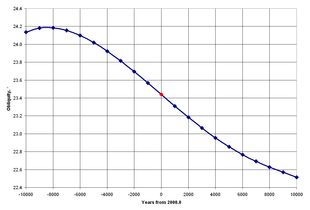
Obliquity of the ecliptic for twenty,000 years, from Laskar (1986).[14] Annotation that the obliquity varies only from 24.2° to 22.5° during this time. The red point represents the twelvemonth 2000.
Until 1983 the obliquity for whatever date was calculated from work of Newcomb, who analyzed positions of the planets until about 1895:
ε = 23°27′08.26″ − 46.845″ T − 0.0059″ T 2 + 0.00181″ T 3
where ε is the obliquity and T is tropical centuries from B1900.0 to the date in question.[xv]
From 1984, the Jet Propulsion Laboratory's DE series of calculator-generated ephemerides took over as the cardinal ephemeris of the Astronomical Annual. Obliquity based on DE200, which analyzed observations from 1911 to 1979, was calculated:
ε = 23°26′21.45″ − 46.815″ T − 0.0006″ T ii + 0.00181″ T 3
where hereafter T is Julian centuries from J2000.0.[sixteen]
JPL's primal ephemerides have been continually updated. The Astronomical Almanac for 2010 specifies:[17]
ε = 23°26′21.406″ − 46.836769″ T − 0.0001831″ T 2 + 0.00200340″ T 3 − 0.576×10−vi″ T 4 − 4.34×10⁻⁸″ T five
These expressions for the obliquity are intended for loftier precision over a relatively short time span, maybe several centuries.[18] J. Laskar computed an expression to order T 10 practiced to 0.04″/1000 years over 10,000 years.[14]
All of these expressions are for the mean obliquity, that is, without the nutation of the equator included. The true or instantaneous obliquity includes the nutation.[19]
Plane of the Solar Organization [edit]
Almost of the major bodies of the Solar System orbit the Sun in nearly the same plane. This is likely due to the way in which the Solar System formed from a protoplanetary disk. Probably the closest current representation of the deejay is known as the invariable aeroplane of the Solar System. Earth's orbit, and hence, the ecliptic, is inclined a trivial more than 1° to the invariable plane, Jupiter's orbit is within a piffling more than 1⁄2 ° of it, and the other major planets are all inside about 6°. Because of this, about Solar System bodies announced very close to the ecliptic in the sky.
The invariable plane is defined by the angular momentum of the unabridged Solar System, substantially the vector sum of all of the orbital and rotational angular momenta of all the bodies of the system; more than 60% of the total comes from the orbit of Jupiter.[20] That sum requires precise noesis of every object in the system, making information technology a somewhat uncertain value. Because of the incertitude regarding the exact location of the changeless plane, and considering the ecliptic is well divers past the apparent motion of the Lord's day, the ecliptic is used as the reference plane of the Solar Arrangement both for precision and convenience. The just drawback of using the ecliptic instead of the invariable airplane is that over geologic time scales, it volition move against fixed reference points in the sky'due south distant background.[21] [22]
Celestial reference aeroplane [edit]

The ecliptic forms one of the ii fundamental planes used as reference for positions on the celestial sphere, the other existence the celestial equator. Perpendicular to the ecliptic are the ecliptic poles, the north ecliptic pole being the pole n of the equator. Of the 2 fundamental planes, the ecliptic is closer to unmoving against the background stars, its motility due to planetary precession being roughly 1/100 that of the angelic equator.[23]
Spherical coordinates, known as ecliptic longitude and latitude or angelic longitude and latitude, are used to specify positions of bodies on the celestial sphere with respect to the ecliptic. Longitude is measured positively eastward[5] 0° to 360° along the ecliptic from the vernal equinox, the same direction in which the Lord's day appears to movement. Latitude is measured perpendicular to the ecliptic, to +xc° due north or −90° southward to the poles of the ecliptic, the ecliptic itself being 0° latitude. For a complete spherical position, a distance parameter is also necessary. Different distance units are used for different objects. Within the Solar Arrangement, astronomical units are used, and for objects near Earth, Globe radii or kilometers are used. A respective correct-handed rectangular coordinate system is also used occasionally; the x-centrality is directed toward the vernal equinox, the y-axis 90° to the e, and the z-axis toward the n ecliptic pole; the astronomical unit is the unit of measure. Symbols for ecliptic coordinates are somewhat standardized; see the table.[24]
| Spherical | Rectangular | |||
| Longitude | Breadth | Distance | ||
| Geocentric | λ | β | Δ | |
| Heliocentric | l | b | r | x, y, z [annotation 1] |
| ||||
Ecliptic coordinates are user-friendly for specifying positions of Solar Organisation objects, every bit most of the planets' orbits have minor inclinations to the ecliptic, and therefore always announced relatively shut to it on the heaven. Because Globe'southward orbit, and hence the ecliptic, moves very little, information technology is a relatively stock-still reference with respect to the stars.

Inclination of the ecliptic over 200,000 years, from Dziobek (1892).[26] This is the inclination to the ecliptic of 101,800 CE. Note that the ecliptic rotates past merely about 7° during this time, whereas the celestial equator makes several complete cycles around the ecliptic. The ecliptic is a relatively stable reference compared to the angelic equator.
Because of the precessional motility of the equinox, the ecliptic coordinates of objects on the celestial sphere are continuously irresolute. Specifying a position in ecliptic coordinates requires specifying a detail equinox, that is, the equinox of a particular date, known as an epoch; the coordinates are referred to the direction of the equinox at that date. For instance, the Astronomical Annual [27] lists the heliocentric position of Mars at 0h Terrestrial Time, four January 2010 as: longitude 118°09′15.8″, breadth +one°43′16.vii″, true heliocentric altitude 1.6302454 AU, mean equinox and ecliptic of appointment. This specifies the mean equinox of iv January 2010 0h TT as to a higher place, without the improver of nutation.
Eclipses [edit]
Considering the orbit of the Moon is inclined simply most v.145° to the ecliptic and the Sunday is e'er very near the ecliptic, eclipses ever occur on or near information technology. Because of the inclination of the Moon's orbit, eclipses practice non occur at every conjunction and opposition of the Sunday and Moon, simply only when the Moon is almost an ascending or descending node at the same time information technology is at conjunction (new) or opposition (full). The ecliptic is and then named because the ancients noted that eclipses simply occur when the Moon is crossing it.[28]
Equinoxes and solstices [edit]
| ecliptic | equatorial | |
| longitude | right ascension | |
| March equinox | 0° | 0h |
| June solstice | 90° | 6h |
| September equinox | 180° | 12h |
| December solstice | 270° | 18h |
The exact instants of equinoxes and solstices are the times when the apparent ecliptic longitude (including the effects of aberration and nutation) of the Sun is 0°, 90°, 180°, and 270°. Considering of perturbations of Globe's orbit and anomalies of the calendar, the dates of these are non fixed.[29]
In the constellations [edit]

Equirectangular plot of declination vs right rising of the modern constellations with a dotted line denoting the ecliptic. Constellations are colour-coded by family and year established. (detailed view)
The ecliptic currently passes through the following constellations:
- Pisces
- Aries
- Taurus
- Gemini
- Cancer
- Leo
- Virgo
- Libra
- Scorpius
- Ophiuchus[30]
- Sagittarius
- Capricornus
- Aquarius
Astrology [edit]
The ecliptic forms the center of the zodiac, a celestial belt about 20° broad in latitude through which the Sun, Moon, and planets always appear to move.[31] Traditionally, this region is divided into 12 signs of 30° longitude, each of which approximates the Sun's move in one month.[32] In ancient times, the signs corresponded roughly to 12 of the constellations that straddle the ecliptic.[33] These signs are sometimes still used in modernistic terminology. The "Kickoff Betoken of Aries" was named when the March equinox Dominicus was actually in the constellation Aries; it has since moved into Pisces because of precession of the equinoxes.[34]
See also [edit]
- Formation and evolution of the Solar System
- Invariable airplane
- Protoplanetary deejay
- Angelic coordinate organisation
Notes and references [edit]
- ^ Strictly, the aeroplane of the mean orbit, with small-scale variations averaged out.
- ^ USNO Nautical Almanac Office; United kingdom of great britain and northern ireland Hydrographic Office, HM Nautical Almanac Office (2008). The Astronomical Almanac for the Year 2010. GPO. p. M5. ISBN978-0-7077-4082-nine.
- ^ "LEVEL 5 Dictionary and Glossary of Terms".
- ^ "The Ecliptic: the Sunday'south Annual Path on the Celestial Sphere".
- ^ U.S. Naval Observatory Nautical Annual Office (1992). P. Kenneth Seidelmann (ed.). Explanatory Supplement to the Astronomical Almanac. University Science Books, Mill Valley, CA. ISBN0-935702-68-7. , p. xi
- ^ a b c The directions north and due south on the celestial sphere are in the sense toward the n celestial pole and toward the s celestial pole. East is the direction toward which Earth rotates, west is opposite that.
- ^ Astronomical Almanac 2010, sec. C
- ^ Explanatory Supplement (1992), sec. ane.233
- ^ Explanatory Supplement (1992), p. 733
- ^ Astronomical Annual 2010, p. M2 and M6
- ^ Explanatory Supplement (1992), sec. ane.322 and three.21
- ^ U.S. Naval Observatory Nautical Almanac Office; H.M. Nautical Almanac Part (1961). Explanatory Supplement to the Astronomical Ephemeris and the American Ephemeris and Nautical Annual. H.Thou. Jotter Office, London. , sec. 2C
- ^ Explanatory Supplement (1992), p. 731 and 737
- ^ Chauvenet, William (1906). A Manual of Spherical and Practical Astronomy. Vol. I. J.B. Lippincott Co., Philadelphia. , art. 365–367, p. 694–695, at Google books
- ^ a b Laskar, J. (1986). "Secular Terms of Classical Planetary Theories Using the Results of General Relativity". Bibcode:1986A&A...157...59L. , table 8, at SAO/NASA ADS
- ^ Explanatory Supplement (1961), sec. 2B
- ^ U.South. Naval Observatory, Nautical Almanac Part; H.M. Nautical Almanac Office (1989). The Astronomical Almanac for the Year 1990. U.S. Govt. Printing Part. ISBN0-11-886934-5. , p. B18
- ^ Astronomical Annual 2010, p. B52
- ^ Newcomb, Simon (1906). A Compendium of Spherical Astronomy. MacMillan Co., New York. , p. 226-227, at Google books
- ^ Meeus, Jean (1991). Astronomical Algorithms. Willmann-Bong, Inc., Richmond, VA. ISBN0-943396-35-2. , chap. 21
- ^ "The Mean Aeroplane (Changeless Plane) of the Solar Organization passing through the barycenter". 3 Apr 2009. Archived from the original on 3 June 2013. Retrieved 10 April 2009. produced with Vitagliano, Aldo. "Solex 10". Archived from the original (computer program) on 29 April 2009. Retrieved x April 2009.
- ^ Danby, J.M.A. (1988). Fundamentals of Celestial Mechanics. Willmann-Bell, Inc., Richmond, VA. department nine.i. ISBN0-943396-20-4.
- ^ Roy, A.East. (1988). Orbital Move (third ed.). Constitute of Physics Publishing. section 5.3. ISBN0-85274-229-0.
- ^ Montenbruck, Oliver (1989). Practical Ephemeris Calculations. Springer-Verlag. ISBN0-387-50704-three. , sec one.iv
- ^ Explanatory Supplement (1961), sec. 2A
- ^ Explanatory Supplement (1961), sec. 1G
- ^ Dziobek, Otto (1892). Mathematical Theories of Planetary Motions. Register Publishing Co., Ann Arbor, Michigan. , p. 294, at Google books
- ^ Astronomical Almanac 2010, p. E14
- ^ Ball, Robert Due south. (1908). A Treatise on Spherical Astronomy. Cambridge University Press. p. 83.
- ^ Meeus (1991), chap. 26
- ^ Serviss, Garrett P. (1908). Astronomy With the Naked Eye. Harper & Brothers, New York and London. pp. 105, 106.
- ^ Bryant, Walter W. (1907). A History of Astronomy. p. 3. ISBN9781440057922.
- ^ Bryant (1907), p. 4.
- ^ See, for example, Leo, Alan (1899). Star divination for All. L.N. Fowler & Visitor. p. 8.
astrology.
- ^ Vallado, David A. (2001). Fundamentals of Astrodynamics and Applications (2nd ed.). El Segundo, CA: Microcosm Press. p. 153. ISBNane-881883-12-iv.
External links [edit]
 | Expect up ecliptic in Wiktionary, the complimentary dictionary. |
- The Ecliptic: the Sun'southward Annual Path on the Celestial Sphere Durham University Section of Physics
- Seasons and Ecliptic Simulator University of Nebraska-Lincoln
- MEASURING THE SKY A Quick Guide to the Angelic Sphere James B. Kaler, University of Illinois
- Earth's Seasons U.South. Naval Observatory
- The Basics - the Ecliptic, the Equator, and Coordinate Systems AstrologyClub.Org
- Kinoshita, H.; Aoki, South. (1983). "The definition of the ecliptic". Celestial Mechanics. 31 (4): 329–338. Bibcode:1983CeMec..31..329K. doi:ten.1007/BF01230290. S2CID 122913096. ; comparison of the definitions of LeVerrier, Newcomb, and Standish.
Source: https://en.wikipedia.org/wiki/Ecliptic
0 Response to "what is the name given to the path of the earth as seen from the sun?"
Postar um comentário