1992 Full Size Truck 454 Engine Starts but Then Dies It Will Start but Die Again
ДЕПАРТАМЕНТ ЛЕСНОГО ХОЗЯЙСТВА НИЖЕГОРОДСКОЙ ОБЛАСТИ
Государственное бюджетное профессиональное
образовательное учреждение Нижегородской области
«КРАСНОБАКОВСКИЙ ЛЕСНОЙ КОЛЛЕДЖ»
Утверждаю
Зам. директора по УР
ГБПОУ НО «КБЛК»
_________О.Н. Спирин
МЕТОДИЧЕСКИЕ УКАЗАНИЯ
по дисциплине «Английский язык»
для студентов Ii курса
тема two
«История развития автомобилестроения»
для специальности 23.02.07 «Техническое обслуживание
и ремонт двигателей, систем и агрегатов автомобилей»
| РАССМОТРЕНО: на заседании предметно-цикловой комиссии общеобразовательных дисциплин ПРОТОКОЛ № от « » сентября 2019г. Председатель ПЦК _ ____________ _____ | Разработала: преподаватель иностранных языков Воронина М.В. |
Красные Баки
2019
Данное учебное пособие предназначено для студентов специальности «Техническое обслуживание и ремонт двигателей, систем и агрегатов автомобилей» по дисциплине «Иностранный язык (английский)». В пособие включены технические тексты и тексты для дополнительного чтения. Материал представлен для изучения и закрепления специальной лексики будущих специалистов.
Оглавление
| History of the automobile ……………………………………………….….... Inventors of the commencement cars…………………………………………………….... Russian automobile engineering...…………...…………………….…….…… Motorcar production.….……………………….……………………………. Список литературы …………………………………………………………... | 4 9 1 7 19 21 |
HISTORY OF THE Machine
Задание 1. Выпишите новые слова и словосочетания:
to propel a vehicle – передвижное транспортное средство
a steam boiler – паровой котел
a steam jet – паровые струи
rear – задняя часть
self - propelled vehicle – самодвижущееся средство передвижения
steam-driven carriage – экипаж, приводимый в движение паром
3-wheeled carriage – three- колесный экипаж
brake – тормоз
roller – каток
gear-box – коробка передач
steam-engine – паровой двигатель
internal combustion engine – двигатель внутреннего сгорания
ignite – зажигать, воспламенятся
electric spark – электрическая искра
iv-stroke cycle engine – 4- тактовый двигатель
conventional vehicles – обычное средство передвижения
frazzle – выхлоп
gallon of fuel – галлон топлива (от three,79 до 4,55 литра)
mileage – пробег
is drawn into – вовлекать, втягивать
pressure – давление
petroleum – нефть
alloys - сплавы
external - внешний
burner – камера сгорания
Задание 2. Прочитайте и переведите текст:
The history of the auto goes back several hundred years. One of the earliest attempts to propel a vehicle past mechanical ability was suggested by sir Isaac Newton about 1680. It was little more a toy consisting of a steam boiler supplying a steam jet turned to the rear.
However, the credit for building the first self-propelled route vehicle must undoubtedly go to the French military engineer, Nicholas Cugnot ( Кюньо ). Between 1763 and 1769 two steam-driven carriages were built and tried.
In 1784 the Russian inventor Kulibin built a three-wheeled carriage. In his vehicle he used for the first time such new elements as brakes, rollers and a gear-box. The first Englishman to build a full-size self-propelled vehicle for use on the roads and to obtain practical results was Threvithick ( Тревитик ). Between 1798-1800 he congenital several working models.
Up to 1860 about of route vehicles were powered by steam engines which ran at slow speeds. In 1860 Lenior ( Ленуар ) of Paris built an internal combustion engine which ran on city gas, the gas beingness ignited past an electric spark. In 1866, Otto invented the type of 4-stroke wheel engine which is used today.
Slowly simply surely the auto industry is perfecting a number of alternatives to the conventional engines institute in almost all of today's rider cars. Two prime factors lie behind the search for unlike engines - the necessity to reduce air pollution by requiring cleaner auto exhaust and the desire to produce cars that will run farther on a gallon of fuel. While basic research is continuing on electric and steam powered engines, the diesel, turbine and Stirling are electric current industry favourites.
Diesels become improve mileage than gasoline engines, and the fuel is commonly cheaper. In 1890's, Rudolf Diesel fuel, invented the engine that bears his name. As air is fatigued into the engine and compressed internal temperatures rising, and pressures reach 2 to 3 times those in a gasoline engine. The extreme pressures accept meant that diesels usually are much larger and heavier than gasoline engines of the same power potential.
The disadvantages of diesels equally passengers - car engines are boring performance, dissonance and smoke.
The turbine and Stirling are multifuel engines, capable of running on any liquid that volition burn down, including such exotic types as peanut oil and perfume. This would be a major advantage if severe petroleum shortages develop.
The turbine cars now operating are handbuilt models that toll more one million dollars each. Alloys of precious metals of loftier durability are still required for sure vital turbine parts. Engineers believe that progress in ceramics hold the primal to making turbines practical alternatives to nowadays-day engines.
The Stirling concept, starting time offered more than 150 years ago past a Scottish clergyman, involves external instead of internal combustion. In the new design, hydrogen gas is heated by a burner, which can run on almost all kinds of fuel. Engineers signal out that a Stirling engine would be quieter than an equivalent internal combustion engine, would emit less toxic gases, and would use fuel more economically.
Yet, in that location is still stance in the car industry that the conventional gasoline powered engine - the type in almost universal utilize now - will continue to dominate until or unless outside circumstances dictate otherwise.
Задание iii. Answer the questions.
one. Who made an attempt to propel a vehicle?
ii. Who congenital the get-go self-propelled road vehicle?
3. What kind of carriage did the Russian inventor Kulibin build in 1784?
4. What did Kulibin use in his vehicle for the showtime time?
v. What were all route vehicles up to 1860 powered by?
vi. What did Lenoir built in 1860?
7. How did an internal combustion engine run on?
eight. When was the iv-stroke bicycle engine invented?
9. What are the primary factors that are of import search for different engines?
ten. Why are these factors very important?
11. What are the disadvantages of diesel?
12. When was the Stirling engine invented?
13. Will electric cars replace the conventional vehicles?
14. What kind of engine will dominate in the most hereafter?
Задание 4. Выпишите предложения где говорится:
a) o первых попытках использовать механическую энергию для приведения в движение экипажа;
б) об основных требованиях, предъявляемых к автомобилю.
Задание v. Выберите утверждения, соответствующие содержанию текста.
ane. The history of the car goes dorsum...
a) a hundred years;
b) a k years;
с ) several hundred years.
two. Diesels are usually much larger and heavier than...
a) gasoline engines;
b) turbine cars;
c) Stirling engines.
3. The disadvantages of diesels are...
a) low speeds;
b) dissonance and smoke;
c) heavy weights.
iv. The turbine and Stirling are multifuel engines, capable of running on...
a) petrol simply;
b) peanut oil and perfume;
c) benzene.
Задание half dozen. Прочтите текст еще раз, обращая внимание на даты, цифры и связанные с ними факты. Выпишите эти предложения.
Задание 7. Переведите на русский язык следующие слова и словосочетания:
vehicle, mechanical power, self-propelled, was constructed, a steam-driven carriages, wheels, passengers, motor cars, issued, prosecuted, of gasoline engines, introduced the four-stroke bicycle of operation, two-seated cars, efficient, international combustion engine, abolition, automobile industry, collect antique cars, advertisements.
Задание viii. Закончите предложения , используя текст
ane) In … the Russian inventor Kulibin built a three-wheeled carriage.
two) Diesels become improve … than gasoline engines, and the fuel is normally cheaper.
3) Alloys of precious metals of loftier durability are nonetheless required for certain …
4) In the new pattern, … gas is heated by a burner.
v) One of the primeval attempts to propel a vehicle by … was suggested by sir Isaac Newton.
Задание 9. Расскажите об истории автомобилестроения, используя следующие выражения и глаголы:
the history of the automobile mechanical ability, a steam boiler, selfpropelled, vehicle steam-driven carriages, brakes, gear-box, steam engines, internal-combustion engine, air-pollution, diesel fuel engines, turbine cars, Stirling engine;
to go back, to propel, to build, to use, to obtain, to be powered by, to invent, to reduce, to produce, to offer, to involve, to dominate.
Задание ten. Подберите к слову его описание.
| one. product 2. to pattern three. automobile iv. carriage v. pollution 6. engine 7. vehicle eight. engineer nine. fuel 10. to combust | a. to make or depict plans for something, for example clothes or buildings b. damage acquired to water, air, etc. by harmful substances or waste c. a road vehicle with an engine, four wheels, and seats for a small number of people d. to start to burn down e. a substance that is used to provide estrus or ability, commonly by being burned f. the process of making or growing goods to exist sold 1000. a vehicle with four wheels that is usually pulled by horses and was used mainly in the past h. a car that uses the energy from liquid fuel or steam to produce movement i. a person whose task is to repair or control machines, engines, or electrical equipment j. a machine, usually with wheels and an engine, used for transporting people or goods on state, peculiarly on roads |
Additional texts
History of the automobile
The Ford Model T (foreground) and Volkswagen Beetle (groundwork) are among the nigh mass-produced automobile models in history.
The early history of the automobile can be divided into a number of eras, based on the prevalent ways of propulsion. After periods were defined by trends in exterior styling, size, and utility preferences.
In 1769 the first steam-powered automobile capable of human transportation was built by Nicolas-Joseph Cugnot.
In 1808, François Isaac de Rivaz designed the first car powered past an internal combustion engine fueled by hydrogen.
In 1870 Siegfried Marcus built the first gasoline powered combustion engine, which he placed on a pushcart, building four progressively sophisticated combustion-engine cars over a 10-to-15-year span that influenced later on cars. Marcus created the two-cycle combustion engine. The motorcar's 2nd incarnation in 1880 introduced a 4-cycle, gasoline-powered engine, an ingenious carburetor design and magneto ignition. He created an boosted two models further refining his design with steering, a clutch and a restriction.
The iv-stroke petrol (gasoline) internal combustion engine that still constitutes the most prevalent form of modernistic automotive propulsion was patented by Nikolaus Otto. The similar 4-stroke diesel engine was invented by Rudolf Diesel. The hydrogen fuel cell, i of the technologies hailed as a replacement for gasoline as an energy source for cars, was discovered in principle by Christian Friedrich Schönbein in 1838. The battery electric car owes its beginnings to Ányos Jedlik, 1 of the inventors of the electrical motor, and Gaston Planté, who invented the pb–acid battery in 1859.
In 1885, Karl Benz developed a petrol or gasoline powered car. This is likewise considered to be the kickoff "production" vehicle as Benz made several other identical copies. The automobile was powered by a unmarried cylinder iv-stroke engine.
In 1913, the Ford Model T, created by the Ford Motor Company 5 years prior, became the first motorcar to be mass-produced on a moving assembly line. By 1927, Ford had produced over fifteen,000,000 Model T automobiles.
At the plow of the 20th century electrically powered automobiles became a popular alternative method of automobile propulsion.
INVENTORS OF THE FIRST CARS
Задание 1. Выпишите новые слова и словосочетания:
| advance, advanced, reward | продвигать, современный, преимущество |
| candle, candle light | свеча, свет от свечи |
| pharmacist | химик |
| code, Morse lawmaking | код, азбука Морзе |
| design, to design | дизайн, конструировать |
| diesel | дизель |
| discovery | открытие |
| dot-and-dash alphabet | азбука Морзе |
| due to | благодаря |
| engine | двигатель |
| steam engine | паровой двигатель |
| internal combustion engine | двигатель внутреннего сгорания |
| petrol engine | бензиновый двигатель |
| fire | стрелять, палить |
| fire bullets | стрелять пулями |
| flunk | потерпеть фиаско |
| fuel | топливо, горючее |
| run on fuel | передвигаться на топливе |
| horsepower | лошадиная сила |
| invent, inventor, invention | изобретать, изобретатель, изобретение |
| patent | патентовать |
| penetrate | проникать, пропускать |
| to perfect | усовершенствовать |
| to produce | производить, вырабатывать |
| reliable | надежный, прочный |
| rubber, prophylactic solution | резина, каучуковый раствор |
| to split | расщеплять, раскалывать |
| to succeed in | преуспевать в |
Задание two. Прочитайте и переведите текст:
Over the centuries, man's way of life was changed by a relatively small number of discoveries and inventions. Just changes have come more than and more often since the steam engine was invented in 1765 past James Watt. In but two hundred years, man advanced from horsepower and candle light to aeroplanes and neon lams. Our ideas about travel have changed completely since Gottlieb Daimler and Charles Benz built their kickoff petrol engine in 1885 and the Wright Brothers made the first flight in 1903.
In 1897 Rudolf Diesel invented a new internal combustion engine. It is known as a diesel and information technology began a send revolution in cars, lorries, trains and ships. The main advantage of diesels is that they run on rather inexpensive fuel.
Charles Rolls was a British aristocrat and man of affairs, who was specially interested in cars. One time he met another enthusiast of cars Henry Royce, a famous car engineer. They decided to pattern the about comfortable and reliable motorcar. At the start of the 20th century information technology seemed to be a fantasy. Merely in 1907 they managed to create the world – famous Rolls – Royce auto. Information technology was so comfortable and reliable that one of the models "Silvery ghost" hadn't changed greatly for 20 years since 1907.
Samuel Colt, who was an American, designed and patented a pistol in 1836. It had a revolving butt and could burn down 6 bullets ane after the other. It was the showtime pistol of its kind. Later on in that location came many other pistols with half dozen bullets.
Samuel Finley Morse was a portrait painter, who became an inventor. For 12 years he tried to perfect the telegraph and succeeded in inventing the telegraphic dot - and – dash alphabet, now known as Morse code. Though there were some other codes in America in the nineteenth century, Morse lawmaking is used present all over the world.
Charles Makintosh was a chemist by profession. He worked in a textile manufacture and in 1823 he developed a rubber solution used for raincoat production. Raincoats with this rubber solution didn't allow water to penetrate. These raincoats were called makintoshes and people employ them in rainy weather.
Some people say we live in the age of computers; but it is also correctly described as the atomic age or the infinite age. Today, a journey from London to Cairo takes hours. Only a hundred years ago it took weeks. Today, men recall seriously of going to Mars. 50 years ago they only dreamt about it. Today we produce energy by splitting the atom. A century ago, no i believed it could be divide. Due to inventions, technology has advanced so quickly that cars and televisions are out of date but a few years after they were made.
Задание 3. Соедините части предложения
| 1. A steam engine … | a. very pop even nowadays |
| 2. A new internal combustion engine… | b. was the most comfortable and reliable machine. |
| 3. The main advantage of diesels is… | c. was invented by Rudolf Diesel. |
| 4. The world famous Rolls Royce motorcar… | d. was invented by James Watt. |
| 5. All the cars produced by the business firm "Daimler-Benz"… | e. was a auto engineer past profession. |
| vi. Henry Royce …. | f. were called "Mercedes-Benz". |
| 7. A German language engineer Rudolf Diesel … | 1000. fabricated his famous invention in 1897. |
| 8. Morse code is … | h. that they run on rather cheap fuel. |
Задание four. Выберите продолжение предложений
1. Changes in the man's style of life have get more evident since
a) the discovery of a pistol with 6 bullets;
b) 1765;
c) the birth of Edison, 1 of the greatest inventors;
d) the first patented invention was registered.
2. An invention is
a) the case of finding something which existed before but was not known to people. It is often a place or a scientific fact;
b) a difficulty that needs attention and thought in order to solve information technology;
c) something that is finished or gained through skill or hard piece of work;
d) a useful affair or idea which is produced by scientists for the kickoff time.
three. The "Silver Ghost" model was
a) famous for its reliability and condolement;
b) created past Wright brothers;
c) one of the best racing cars at the beginning of the 20thursday century.
d) named afterward its creator Tom Silver.
4. Due to the evolution of a rubber solution
a) raincoats were called makintoshes;
b) a send revolution began;
c) the production of waterproof raincoats was quite successful;
d) raincoats became very pop.
Задание v. Поставьте предложения в хронологическом порядке.
ane) These two inventors managed to blueprint the almost reliable and comfortable car for the starting time of the last century.
ii) He invented the first gun with 6 bullets.
three) This invention got its proper name after the inventor and is used in rainy weather condition.
four) The invention of this engine gave birth to a large number of other discoveries and inventions.
five) This invention is used nowadays all over the globe though there were another inventions on illustration in the 19thursday century.
6) Last century was remarkable for the introduction of the light amplification by stimulated emission of radiation, the proliferation of calculators and computers and a revolution in the telecommunication manufacture
7) The master advantage of that invention was that it used rather cheap fuel.
Задание 6. Допишите предложения, используя текст:
1) Changes accept come more and more often since…
2) The main advantages of diesels is …
3) Charles Rolls was a British blueblood and businessman…
four) Some people say nosotros live ….
5) Today men recall ….
half dozen) Due to inventions ….
Задание 7. Напишите, что изобрели эти люди :
1) R. Diesel
two) S. Colt
3) C. Rolls
4) C. Makintosh
5) S. Morse
6) C. Benz
Задание 8. Заполните пропуски, изменив слова справа
| 1. His____ could non be used to protect tall buildings during a storm. | DISCOVER |
| 2. This ______ became very pop because information technology gave off much oestrus. | INVENT |
| 3. He persuaded the _______ to try locomotives. | DIRECT |
| 4. The ______ of the colliery bought some engines and began to experiment for himself. | Own |
| v. Samuel Morse was the pioneer of the most widely used electrical _____ in the world today. | COMMUNICATE |
| vi. What he needed was a _____ lamp. | Prophylactic |
| vii. Franklin'south _____ almost natural phenomena tin can be observed from his adolescence. | CURIOUS |
| eight. At that time people were _____ afraid of lightning. | TERRIBLE |
| nine. One mean solar day he brought a new _______ to the laboratory. | TRANSMIT |
Задание 9. Соедините слова из обоих столбцов, чтобы получились словосочетания, переведите их:
| A | B |
| lightning | service |
| metal | power |
| steam | lines |
| railroad | lamps |
| coal | conductor |
| telegraph | light |
| equus caballus | locomotive |
| rider | gas |
| oil | engine |
| candle | fundamental |
Задание 10. Прочитайте и переведите текст. Выпишите выделенные слова с переводом.
Inventors on both sides of the Atlantic discovered during the 1880s that technologies for making self-propelled carriages and wagons had progressed dramatically. Presently sundry vehicles powered by steam, internal combustion engines, and electricity were rolling beyond Frg, French republic, and the United States.
The offset practical internal combustion engine was built by Etienne Lenoir, a Belgian living in France. Patented in 1860, his h2o-cooled contraption burned coal gas and was noisy and inefficient; all the same, for two decades information technology had many buyers. Lenoir'south engine was a clear proof of concept to other inventors, especially in Europe.
Nikolaus Otto, a German, was 1 of many inspired past Lenoir's technical and commercial success. Mechanically gifted, Otto sought to better the Lenoir engine, and in the late 1870s he did. Otto'due south four-bike design embodied features that would become standard in gasoline automobile engines.
The cars of that time were very small-scale, two-seated cars with no roof, driven by an engine placed under the seat. Motorists had to carry large cans of fuel and split up spare parts, for in that location were no repair or filling stations to serve them.
The Otto engine and the many clones it spawned, though intended to replace small-scale steam engines in industry, inaugurated the era of the gasoline-powered automobile. Conspicuously, the compact internal combustion engine was a most suitable technology for the self-propelled vehicle.
Karl Benz, also a German, employed his ain Otto-type engine to ability a three-bicycle railroad vehicle in 1885. These tri-wheelers, with a one-cylinder engine that developed 0.8 hp, were put on the market in 1887, mayhap the earliest commercial automobiles.
In 1891 Benz added a four-bicycle motorized carriage to his company's offerings. These automobiles sold well and were widely imitated. In the early 1890s, for example, Planhardet Levassoras well as Pfeugeot in French republic were peddling cars to the public. Henry Ford, however, was still a long way from edifice automobiles.
Задание 11. Найдите в тексте синонимы слова vehicle .
Задание 12. Заполните пропуски в предложениях, в соответствии с содержанием текста и переведите предложения.
1. Inventors on both sides of the Atlantic … during the 1880s that technologies … had progressed dramatically.
2. Patented in 1860, his water-cooled contraption … and was … and … .
iii. Otto'south four-cycle design … that would become standard in … engines.
4. Motorists had to carry … and separate … , for there were no … or … to serve them.
five. The meaty internal combustion engine was a most … for the … .
six. Karl Benz … his own Otto-type engine … a three-wheel carriage in 1885.
Задание 13. Ответьте на вопросы и перескажите текст
1. Who built the first practical internal combustion engine?
ii. Who improved the Lenoir engine?
iii. What era did the Otto engine inaugurate?
4. Who introduced the First commercial auto?
Additional texts
Karl Benz and Nicolaus Otto
Benz, Karl (1844 — 1929) was a German inventor of the machine, who devoted his life to making a horseless vehicle. When Benz's three-wheeled engine-driven machine (the first "car") appeared on I lie streets in 1885, people couldn't believe that it moved without the aid of horses. Information technology was a great triumph to him because Benz built a new engine that was lighter and more powerful than whatever other. He put it onto a chassis and got power from the engine to the wheels. Benz's first car was a great accomplishment for him. Everything — the engine, fuel transmission, controls — had been developed and designed by him. The wheels were driven by ways of a chain, and there were ii speeds.
In his early on days the speed limits were 12 kilometers an hr outside the metropolis, six - inside. Benz realized that he would never be able to ameliorate his cars if this rule were not changed. He thought up a program. He invited the Minister to ride in his car and agreed with a milkman that the latter would wait with his horse for them on a certain identify. When Benz, with the Minister in his car, passed the milkman, the latter started off, passed the auto at a good speed and laughed at them. The plan worked perfectly. The Government minister ordered to go faster. But Benz referred to speed limit. "Never listen", said the Government minister. Thus Benz won the twenty-four hours.
Nicolaus Otto (June 14, 1832 – January 26, 1891) – ane of the virtually important landmarks in engine pattern comes from Nicolaus Otto who in 1876 invented an effective gas motor engine—the get-go practical alternative to the steam engine. Otto built the offset practical four-stroke internal combustion engine called the "Otto Cycle Engine," and when he completed his engine, he built it into a motorcycle.
In May 1876, Nicolaus Otto congenital the kickoff practical four-stroke piston cycle internal combustion engine. He connected to develop his 4-stroke engine afterwards 1876 and he considered his work finished after his invention of the kickoff magneto ignition system for low voltage ignition in 1884. Otto's patent was overturned in 1886 in favor of the patent granted to Alphonse Beau de Roaches for his 4-stroke engine. However, Otto congenital a working engine while Roaches' blueprint stayed on paper. On October 23, 1877, another patent for a gas motor engine was issued to Nicolaus Otto, and Francis and William Crossley.
In all, Otto congenital the following engines:
· 1861 A copy of Lenoir'southward atmospheric engine
· 1862 A iv-cycle compressed accuse engine (prior to Rochas's patent) which failed every bit it broke most immediately
· 1864 The first successful atmospheric engine
· 1876 The iv-stroke compressed charge engine which is acknowledged every bit the "Otto" cycle engine. The term Otto cycle is applied to all compressed charge, four cycle engines.
Nicolas-Joseph Cugnot
Nicolas-Joseph Cugnot (26 February 1725 – 2 October 1804) was a French inventor. He is believed to have congenital the outset self-propelled mechanical vehicle.
French armed forces engineer designed and built the world'southward outset true automobile, a huge, heavy, steam-powered tricycle.
Afterwards serving in the Austro-Hungarian ground forces in the Vii Years' State of war, Cugnot returned to Paris in 1763 to devote his fourth dimension to writing military treatises and tinkering with a number of inventions he had conceived while campaigning.
He congenital two steam-propelled tractors for hauling artillery, the commencement in 1769, the 2nd in 1770. The second lonely survived and is preserved in the National Conservatory of Arts and crafts, Paris.
This vehicle's two-piston steam engine was designed independently of Thomas Newcomen and James Watt and was based directly on the theoretical descriptions of the French physicist Denis Papin. The engine in it was the first to employ high-pressure steam expansively without condensation. The wagon was tricycle-mounted, with the single front cycle performing both steering and driving functions. The issues of water supply and maintaining pressure severely handicapped the vehicle, which all the same proved the feasibility of steam-powered traction.
Jean Joseph Étienne Lenoir
Étienne Lenoir, (born Jan. 12, 1822, Mussy-la-Ville, Belg.—died Aug. 4, 1900, La Varenne-Saint-Hilaire, Fr.), Belgian inventor who devised the first commercially successful internal-combustion engine.
Lenoir's engine was a converted double-acting steam engine with slide valves to admit the air-fuel mixture and to discharge frazzle products. A ii-stroke bicycle engine, information technology used a mixture of coal gas and air. Though simply nearly iv percent efficient in fuel consumption, it was a smooth-running and durable machine (some machines were in perfect status later 20 years of continuous operation), and by 1865 more than 400 were in use in France and ane,000 in United kingdom of great britain and northern ireland, used for such low-power jobs as pumping and printing.
In 1862 Lenoir built the first automobile with an internal-combustion engine. He had adapted his engine to run on liquid fuel and with his vehicle fabricated a vi-mile (10-kilometre) trip that required ii to three hours. His other inventions include an electric restriction for trains (1855), a motorboat using his engine (1886), and a method of tanning leather with ozone.
Gottlieb Daimler
Gottlieb Daimler, in full Gottlieb Wilhelm Daimler, (born March 17, 1834, Schorndorf, Württemberg [Deutschland]—died March half dozen, 1900, Cannstatt, near Stuttgart), German mechanical engineer who was a major figure in the early history of the automotive industry.
Daimler studied engineering at the Stuttgart polytechnic establish and then worked in various High german engineering firms, gaining feel with engines. In 1872 he became technical director in the business firm of Nikolaus A. Otto, the homo who had invented the four-stroke internal-combustion engine. In 1882 Daimler and his coworker Wilhelm Maybach left Otto's firm and started their own engine-edifice shop. They patented one of the first successful high-speed internal-combustion engines (1885) and developed a carburetor that made possible the employ of gasoline as fuel. The two used their early gasoline engines on a wheel (1885; possibly the kickoff motorbike in the world), a four-wheeled (originally horse-drawn) railroad vehicle driven by a one-cylinder engine (1886), and a boat (1887). The 2 men'due south efforts culminated in a four-wheeled vehicle designed from the start equally an motorcar (1889). This commercially viable vehicle had a framework of light tubing, a rear-mounted engine, belt-driven wheels, and four speeds. In 1890 Daimler-Motoren-Gesellschaft was founded at Cannstatt, and in 1899 the house built the kickoff Mercedes machine.
Charles Stewart Rolls
Charles Stewart Rolls (27 Baronial 1877 - 12 July 1910) was a motoring and aviation pioneer. Together with Frederick Henry Royce he co-founded the Rolls-Royce motorcar manufacturing business firm. He was the first Briton to be killed in a flying accident, when the tail of his Wright Flyer bankrupt off during a flight display most Bournemouth, England. He was aged 32.
Rolls was born in Berkeley Square, London, 3rd son of the 1st Baron Llangattock. Despite his London nascence, he retained a strong family unit connection with his bequeathed home of The Hendre, near Monmouth, Wales. Later attending Mortimer Vicarage Preparatory School in Berkshire, he was educated at Eton Higher where his developing interest in engines earned him the nickname dirty Rolls.
In 1894 he attended a private crammer in Cambridge which helped him gain entry to Trinity College, Cambridge where he studied Mechanical and Technology. In 1896, at the age of 18, he travelled to Paris to buy his first car, a Peugeot Phaeton, and joined the Auto Lodge of French republic. His Peugeot is believed to have been the first car based in Cambridge, and one of the beginning 3 cars owned in Wales. An early on motoring enthusiast, he joined the Self-Propelled Traffic Clan which campaigned against the restrictions imposed on motor vehicles by the Locomotive Human action, and became a founder member of the Car Club of Corking Britain with which it merged 1897.
RUSSIAN Automobile ENGINEERING
Задание 1. Прочтите текст и переведите его письменно.
The motorcar manufacture in our country has been developed since 1916. Before that fourth dimension Russia had no automobile industry at all, technical schools had no departments to railroad train specialists in automobile engineering. Simply in the history of the automobile such names as Shamshurenkov, Blinov, Mamin and other Russian experts in mechanics must be remembered.
The starting time automobile built by Shamshurenkov, a Russian inventor, was put into motion past the pedalling of the driver himself. Blinov designed and constructed tractor driven by steam engine. Mamin was i of the pioneers in Russian internal combustion engines.
Today Russian automobiles are engineered and built in such a mode that they are able to withstand heavy loads for long periods of operation. The modem car is much more a ways of riding from one place to another. The rider's safety and condolement must be considered as much as the car's reliable performance and ability to travel on the highways.
The modern car must have a steel body and a steel roof and this roof must be insulated against the summertime's heat and winter's (erstwhile Ventilation is besides of swell importance. The comfort and convenience of the driver must be taken into consideration too. The automobile must have a heater with special defrosting devices which insure clear vision to the driver. The motorcar must have not bad power for riding, take dependable clutch and brakes, have practiced riding qualities, expert lights, undecayed starting and ignition systems, low fuel consumption, likewise every bit long service life.
Задание 2. Ответьте на вопросы
1. Since what fourth dimension has the auto industry been adult in our land?
2. Who are the most famous Russian experts in mechanics?
3. How was the first automobile put into motion?
4. How are Russian automobiles engineered and built today?
Additional texts
Fyodor Abramovich Blinov and Yakov Mamin
The Russian inventor-taught, a creator of the first in the earth caterpillar tractor, F.A. Blinov was born in 1827 in the village of Nikolskoye in the family of a serf. In 1840 Blinov received his freedom and began to work on a send. Soon he became well-known on the Volga as an experienced master for the repairing of equipment. By 1895 Blinov developed the world'southward first tractor, in which was installed steam auto. Fyodor Abramovich, the creator of the showtime in the world tracked tractor was given the rank of "Honorary denizen of the city Balakovo".
Inventors-self-taught Fyodor Abramovich Blinov and Yakov Mamin glorified Balakovo as the birthplace of the world'southward first caterpillar tractor, wheel self-propelled gun and Russian diesel fuel engine; the found of oil engines and tractors Yakov Mamin in 1915 produced 325 diesel engines, with a full capacity of 5100 horsepower.
Leonty Shamshurenkov
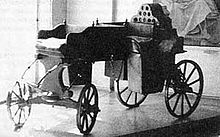
Leonty Luk'yanovich Shamshurenkov (1687—1758) was a self-taught Russian inventor of peasant origin, who designed a device for lifting the Tsar Bong onto a bong-belfry, constructed in 1752 the first self-propelling or self-running carriage (may be regarded as forerunner to both quadrocycle and auto) and proposed projects of an original odometer and self-propelling sledge .
Caterpillar tracks, rail associates
In 1837, Russian ground forces captain Dmitry Zagryazhsky came upwards with drawings of a caterpillar bulldoze and applied to the Ministry of Finance for a patent for his invention of a "carriage with a apartment concatenation mechanical caterpillar". He was granted a patent just his invention did not involvement manufacturers at that time and the patent was annulled in 1839. Much later on, in 1877, Russian peasant and self-taught inventor Fyodor Blinov completed Zagryazhsky'southward unfinshed job and created a wagon that moved on caterpillars. This invention gave the light-green light to product of tractors and, subsequently, of tanks.
Electrically-powered railway wagons
The invention of an electrically-powered railway wagon was a precondition for the transport revolution that spurred the development of towns and industrial centres. It all started in 1874-1876, when Fyodor Pirotsky conducted a slew of experiments on transmitting electricity over a distance, with 1 track serving as a direct usher and the other, as a contrary conductor. An electric motor, located one kilometre from the power source, worked. A few years later, he conducted an experiment at a railway spur most Sestroretsk. There were twoscore people in the wagon. The first electrified tram line was opened as late as 1881 in a Berlin suburb on the ground of designs past the Russian inventor
Helicopter
Igor Sikorsky was another Russian inventor whose potential was fully realized away. In 1910, he created the prototype of a rotor-driven device, which successfully got off the basis. In 1912, he created the outset hydroplane in the globe and and so the showtime multiple-engine aircraft. After the 1917 Revolution in Russian federation, he had to emigrate to the U.s., where he established his ain company, Sikorsky Aero Technology Company, using a contribution from remarkable Russian composer Sergei Rachmaninoff. Sikorsky'south first experimental helicopter designed in the United States got off the basis in September 1939. The pattern of that machine, which has been considered a archetype helicopter design for more than fifty years now, has been used for near 95% helicopters built around the world. In 1942, Sikorsky created a ii-seater helicopter.
AUTOMOBILE PRODUCTION
Задание one. Найдите в правой колонке русские эквиваленты английских слов и словосочетаний:
ane. mechanical engineer а . долгий срок службы
2. to deal ( with ) b . запустить в массовое производство
3.designing cars с . подвергать испытаниям
4. to put into mass production d. плавное сцепление
5. long service life е. отвечать современным требованиям
6. driving safe f . иметь дело (с кем-л., чем-л.)
7. to meet upwardly-to-date demands g. надежные тормоза и рулевое управление
8. shine - acting clutch h . безопасность езды (вождения)
nine. silent gearbox i . бесшумная коробка передач
x. dependable brakes and steering
organization j. инженер - механик
11. to discipline to tests k . конструирование автомобилей
Задание ii. Переведите на русский язык встречающиеся в тексте интернациональные слова:
mechanical, mechanism, specialist, industry, phase, engineering science, process, laboratory, test, fact, automobile, engineer, method, principle, corrosion, type, textile, comfy.
Задание 3. Прочтите текст и выполните следующие за ним упражнения:
1. Specialists in automobile industry deal with designing and manufacturing cars, so they should know that the production of the automobile comprises the following phases:
- designing,
- working out the technology of manufacturing processes,
- laboratory tests,
- road tests,
- mass product (manufacturing).
2. Why is it necessary to know all these facts? It is of import to know them as before the auto (machine or truck) is put into mass production, it should exist properly designed and the automobile must meet upward-to-date requirements.
3. What are these requirements? The auto must accept high efficiency, long service life, driving safety, ease of maintenance and pleasant appearance. In lodge to obtain all these qualities engineers should develop upwardly-to-date methods of designing cars, using new types of resistant to corrosion light materials. As well it is of import to know reckoner science because information technology is intended to shorten the time between designing and manufacturing. Computers offering quick and optimal solutions of problems.
4. But earlier the car is put into mass product all its units and mechanisms are subjected to tests, commencement in the plant'due south laboratory, and so the car undergoes a rigid quality control in route tests. Only then the car is put into mass production. Why are these tests required? What qualities are required of the car? The modern automobile must exist rapid in acceleration, must have polish interim clutch, silent gearbox, dependable brakes and steering system, as well as pleasant advent. Besides it must exist comfortable and take all conveniences.
Задание v. Переведите на русский язык в письменной форме абзацы three и 4.
Задание vi. Ответить на вопросы:
1. What phases does the product of the automobile comprise?
ii. What requirements must the automobile meet?
3. Why are cars subjected to route tests?
four. What qualities are required of the motorcar?
5. Why is it important for the specialists in automobile industry to know calculating methods?
Задание 7. Закончите предложения, выбрав соответствующий вариант окончания:
1. The cars are subjected to route tests in gild....
a) to shorten the time betwixt designing and manufacturing
b) to see up-to-date requirements
c) to work out new technological processes
2. The car must have the following units....
a) high efficiency, long service life, driving safety and pleasant advent;
b) smooth interim clutch, silent gearbox dependable brakes and steering system.
iii. The automobile must have the following qualities....
a) high efficiency, long service life, driving safety and pleasant appearance;
b) smoothen interim clutch, silent gearbox dependable brakes and steering system.
Литература
1. Marie Kavanagh. English for auto industry. – Oxford Concern English, 2016.
2. Герасимова Л.Ф. Автомобиль: Учебное пособие на английском языке для студентов вузов, обучающихся по специальностям: 150200 – Автомобили и автомобильное хозяйство; 240100 – Организация перевозок и управление на транспорте; 240400 – Организация и безопасность движения. В 2 ч. – Омск: Изд-во СибАДИ, 2002.-205 с.
3. Гниненко, А. В. Современный автомобиль как мы его видим : учебник английского языка / А.В. Гниненко. — М.: Астрель: Human action : Транзиткнига, 2005. —461, [three] е.: ил.
4. Шляхова А.В. Английский язык для студентов автомобилестроительных специальностей средних профессиональных учебных заведений: Учеб. пособие/В.А. Шляхова. – М.: Высшая школа, 2008. – 120 с.: илл.
v. Скачано с www.znanio.ru
Source: https://znanio.ru/media/metodicheskie-ukazaniya-po-distsipline-anglijskij-yazyk-dlya-studentov-ii-kursa-istoriya-razvitiya-avtomobilestroeniya-2529484
0 Response to "1992 Full Size Truck 454 Engine Starts but Then Dies It Will Start but Die Again"
Postar um comentário